Showing posts with label writing. Show all posts

Friday, March 13, 2009

Recent Meanderings in Photography: some things I'm thinking about, iii.

There is a sort of narrative created by a photograph. It begins with the unique perspective of the photographer and that photographer’s interaction with his/her subject matter (the subjects chosen, and how they are portrayed). It is set in the historical and even the “factual” moment by the medium used (a photograph taken with a certain kind of film, printed on a certain kind of paper). And the narrative is continued—or completed—in the “life” of the photograph after it has been processed.


Take this photograph, for example, which I found at the site of a homeless camp that had recently been bulldozed. Even without this information, there are several things that might be assumed about the “story” of this photograph, beginning with the portrayal of the subject itself (or himself): photographed from below, he towers over us, shirtless, tattooed, young but intimidating. Is he a gang member? The photograph is a Polaroid. Was it taken in prison? Beyond the image itself, two main things present themselves. The first is the writing on the front and back of the image. “To my Angel + 3 Boys: I think of All 4 of you every second of every day! ♥ Always DADDY,” with a similar message on the back. The second is the dirt residue on both sides of the image. The text serves to soften our impression of the photograph’s subject, and also expands the “story” of the photograph, makes it sadder. Where is this man, I ask, that he can’t be with his children? The dirt (whether or not the viewer knows about the homeless camp) furthers this saddening effect, because it shows that the photograph was left behind, neglected, and this neglect further threatens in the viewer’s mind the relationship between the subject and his “Angel + 3 Boys.”


Besides writing and dirt, there are other things that can be done to the surface of a photograph which change our perception of it, change its story. Puncture holes may indicate that an image was prized enough to be tacked to a bulletin board or cubicle wall. Creases can indicate either neglect or constant use. Was the photograph left on the floor, carried in a wallet, folded and put in a pocket? All these actions have physical effects on the photograph which tell part of a story.


When two girls I know were young, their mother married a pedophile. I don’t know much of what happened while their mother was married to him, but I do know that after she divorced him these girls cut him out of every one of the pictures he was in. In The Golden Bough, Sir James George Frazer describes what he calls “homeopathic magic”:


“Perhaps the most familiar application of the principle that like produces like is the attempt which has been made by many peoples in many ages to injure or destroy an enemy by injuring or destroying an image of him, in the belief that, just as the image suffers, so does the man, and that when it perishes he must die. A few instances out of many may be given to prove at once the wide diffusion of the practice over the world and its remarkable persistence through the ages” (28).


I doubt those young girls were consciously wishing the death of their stepfather when they cut him out of their pictures, but you never know. At the very least, I think they were attempting to symbolically cut him out of their memories. It speaks much for the power we invest in the photographic image.


Another example of this that comes to mind has to do with a discussion I had once with the man at the photo lab. He was working on a project for a funeral; a young man had died, and the family didn’t have any photographs of him with his two children. This man's job was to use a photograph of the dead man with another family member to create two new photographs (in Photoshop) of the man with his two children. He said this was a fairly common assignment, but it seemed so strange to me. It was as if this family was trying to create a past that didn’t exist, a past in which the dead man had been present in his children’s lives, and it seemed to be implicit that by creating a photograph in which it was so, it would be so.


It was all these factors that go into the creation of the found vernacular image, as well as the language of the vernacular image itself, that I attempted to syncretize in order to create my own “fictional” vernacular images. In order to achieve this, I did several things. I began by switching from the 4x5 camera I had been shooting with, to a green plastic 35mm that I found in the closet of the house I was renting. Then, attempting to quash my years of photographic training, I set out to emulate the style of photography I saw in the vernacular photography I had been studying and thinking about. After this, I scanned the negatives, and in Photoshop edited them so that their dimensions, borders, and colors mimicked those of the vintage images I’d found. (It should be noted that two of the images I used were photographs I’d taken when I was about ten. In hindsight, this was inconsistent with the process of the other images, and it would have been better if I’d simply taken new photographs, imitating my ten-year-old aesthetic.) Once I’d edited the images in Photoshop, I printed them, worked the surfaces of the images with pen, soiling, defacement and wear, scanned them again, and reprinted them large, creating new images with a sort of “story.”


What I was doing, self-consciously taking photographs that reference the photograph and the act of photographing, and doing so in a way that is intentionally un-artistic, has been referred to by many as “deskilling.” In the essay “Remembering and Forgetting Conceptual Art,” Alex Klein discusses Jeff Wall’s essay “‘Marks of Indifference’: Aspects of Photography in, or as, Conceptual Art,” in which he described the effects of Conceptual Art on contemporary photographic practice:


“In Wall’s account, the modernist concerns of self-reflexivity and medium specificity are ultimately realized in conceptual artists’ deskilling and amateurization of the photograph. For conceptual artists, photographic depiction is detached from representation and thus points to what Wall calls the “experience of experience.” In this account, conceptual artists’ images are consciously employed and constructed as the antithesis of the highly skilled modernist photograph.”


For William Jenkins, curator of the 1975 exhibition New Topographics, the photographs in that exhibition (by artists such as Lewis Baltz, Robert Adams, Stephen Shore, and Bernd and Hilla Becher) “were characterized by their banality and lack of style” (Klein), a description that it seems could be aptly applied to my “vernacular” images as well. In the exhibition catalogue, he acknowledges that some of the artists in the exhibition were likely influenced by “Ed Ruscha’s deadpan photographs” (ibid.), but states that the chief difference between Ruscha’s conceptual work and that of the New Topographics artists “is the difference between what a photograph is ‘about’ versus what it is ‘of’” (ibid.).


From 26 Gasoline Stations by Ed Ruscha


This leads me to a question: “In my images, is it more important what they are about, or what they’re of?” And I think that the answer is that that yes, like Ruscha’s work, it is more important what they’re about, it’s about the process and the aesthetic, the act of photographing and the language of the vernacular, not so much the specific subject matter of the photographs. And I think I’ll have to leave it there for now.

Thursday, February 26, 2009

Recent Meanderings in Photography: some things I'm thinking about, iii.

I am interested in the idea of creating a narrative through a series of photographs. I'm not thinking here so much of linear (or circular) narratives like those of Duane Michals, but more of accidental narratives created by the personal tastes and ideals of the individual taking and collecting photographs. For example, when I was a child I photographed animals profusely. The images were blurry and out of focus, and sometimes my subject was rendered so small by the Polaroid camera I used as to be almost indistinguishable in the frame. Yet I keep those photographs to this day. There is a power behind those images, in having them, that I don't quite understand yet, but fascinates me. I think part of it is because these Polaroids are amongst my first "creations." Also, I was documenting my "relationships," the relationships of a child whose perfectionist tendencies made the actions of other children seem sometimes indecipherable and alienating. I often turned instead to animals, who I believed could sense something trustworthy and special in me that humans could not, and whose timidity and dependence mirrored my own. And so, in a small way, these images describe me.
Fascination with animals during one's childhood is fairly common. But what about more specific, more descriptive interests and obsessions? I am curious how a person (or perhaps a fictional character) can be described by the photographs they take, and the photographs they choose to keep. I'm quite curious too about the things other than photographs that people collect, and how those might speak about their possessor, but that may be a discussion for another day...

Sunday, February 22, 2009

The Fall

I’ve always thought I could fly.

Less now at age six, but still sometimes

in dreams, when nobody’s looking. So

when Father began working with wax and feathers and thread,

building wings, disembodied, like those of birds,

I saw nothing in them of flying, nothing in them of

me. In my dreams I

fly with my arms, I fly by my strength,

I fly because I am special.

I have no need of these awkward feathered toys

like too-large shoes, lashed

to my arms by Father’s trembling, calloused hands as

with half an ear I listen to his cautious words.


Father is sweating on his forehead,

in his armpits. He shows me how to flap

these wings, he is taking too long.

At last I move my arms, my

sandals kiss grey stones and rough grass

goodbye. Flying is not as easy as I had imagined,

but I learn quickly. Father looks like a wasp buzzing

straight and slow; I am a swallow.

On the beach below, a girl is collecting stones.

Her back is to me, and when she turns,

the stones fall from her hand.

I swoop.

I laugh into her open mouth.


The shore becomes small, and smaller still, a white

scalloped line dividing brown from blue.

I put it behind me. The wind on the sea is cold

and strong, but I am stronger. I climb, then

dive, a thousand swallows beating

in my stomach as I fall, calming when

I spread my wings and right myself. Still Father

plumbs his line, a wasp never faltering between sea

and cloud. Follow me, he said, but I ignore

him now. Clouds are like fine mist against my cheeks,

enveloping white, cool as dawn.


Still I climb. I must be higher now even

than Mount Olympus. I break through the clouds

like a world being born. Everything here is clear, bright,

still. Below me clouds are my own

pillowed bed, broad as the horizon. I

dive into them straight and fast, wings by my sides, head

thrown back, and the clouds swallow me, burning

the insides of my nose like the sea.


I climb. I am brave as any warrior, braver

than Father, higher now than Zeus himself.

I climb. I feel I will never tire. I am swallow,

I am wind, I am cloud, I am sun.

I climb. Nothing now can stop me. Men will speak of me

around campfires at night.


Now feathers begin falling from me one by

one. As they circle

downward, fringed with light, I know

I’m becoming everything I

was meant to be, that soon I will shed these wings,

I will fly with my arms,

I will fly

by my strength.


I find I am screaming my father’s name.

In my stomach

a thousand swallows rage,


I beat my arms but find

no purchase,


I fall.


-g.


The myth of Daedalus and Icarus has always resonated with me. I actually did believe I could fly when I was a child, before I learned to separate dreams from waking. It was something I could only do when no one was watching, my secret gift. I think I've always been afraid that if I were to become all I dream of becoming, if I were to fly, I would outgrow the ones I love and be forced to leave them behind. I would be alone. I know this isn't true, not exactly. Yet see these hobbles? I tie them on myself.

Wednesday, February 18, 2009

Recent Meanderings in Photography: some things I'm thinking about, ii.

As I began looking at vernacular images, my concern was first with the physical aspects of the photographs' contents: the color shifts, depending on the type of film and other factors; compositional similarities, such as the tendency to place the subject in the center of the photograph, or to accidentally crop it out entirely; other interesting compositional accidents, such as the converging angles of the shadows in the image above ; lens flare; lack of focus; over- and under-exposure; etc.
Beyond these superficial elements, I also began thinking about the actual content of the images: the subject matter they portrayed, and how they reflected the perspective of the photographer.

Along these lines, one particular element of these vernacular photographs that I found compelling was their tendency toward the bizarre. When you really look at it, everyday life is filled with bizarre moments, and whether by intent or by accident, many of these vernacular photographs captured this quite strikingly.

And there is humor, whether intended or no:
I also began considering why we take photographs—why we have in the past, and why we do now. It is a way to mark occasions: birthdays, holidays, vacations, celebrations. By marking we remember, by marking we trace the passage of time. Photographing special occasions is also a way to remember the ideal in our lives. We choose the high points, and memorialize them through photographs. There can be an element of fiction-making in this—we "smile for the camera" whether we feel like it or not, cementing for posterity our idealized past.
In Ways of Seeing, John Berger discusses portrait painting as "a celebration of material property and of the status that accompanied it" (110) - that is, the rich displayed their wealth first through the commission of a portrait of themselves, and second through the display of their material possessions in that portrait. I believe there is a similar attention to social status through the display of material goods and leisure activities in vernacular photography.

Tuesday, February 17, 2009

Buy Something

At the gym I can't help watching
television commercials. Even without sound
they make everything seem flat
and meaningless and my legs
want to stop making circles, because
what is the point? It's like driving down the road
and seeing all the other people in
all the other cars. We think so many things
are important. But I can't love you,
not like I should. Not when cars slide along
like they're being pulled by the tabs
in the flat part of a pop-up book. Not
when everything breaks down
into red and green and blue and
all I know is I should buy something.


-g.

Wednesday, February 11, 2009

Practice

Beyond the circle of stadium light
night cuts quick,
my hands untrembling
as they pull stained shin guards and purple socks
over thin bones,
as they knot the fraying laces
of my cleats.
The ball is harsh
and unmanageable.
Dribbling, I run in starts
and stops, inhaling the damp
potpourri of mashed grass
and mud, the chill air searing
the insides of my ribs.
Trailing out behind, I run.

I never consciously wonder if I'll ever be enough.
On defense, I
uproot grass shoots, gnawing
the sweet white of the stalks,
tearing the seeds from the stems.


-g.

Monday, February 9, 2009

Regarding Lauren Greenfield

(c) Lauren Greenfield

It feels like a few words should be said about my previous mishmash of a post. For a while now I have been grappling with the idea of significance in art—that is, it seems that much of contemporary art, when viewed by the average citizen (if viewed by the average citizen), elicits one of two responses: "wow, neat" or "I don't get it." That is, much of contemporary art is so steeped in theory, so necessarily steeped in theory, due to the expectations and demands of the contemporary art world, that it demands at least an explanation, if not an art degree, to be comprehensible. What I've been looking for, and what I'd ideally like to do with my own practice, is to create art that is at once approachable, can hold it's own as fine art, and is significant, i.e. prompts the viewer to re-examine his/her world in a way that promotes positive social change.

(c) Lauren Greenfield

Enter Lauren Greenfield. Her subject matter is often female, often youth. But in looking specifically at this demographic, she addresses pivotal issues—issues that affect every American—and does so in a way that is approachable and relevant. When we watch a documentary such as Thin (which explores the recovery process of anorexic women at the Renfrew Center in Florida), we can't avoid seeing aspects of ourselves in the extreme behaviors of the subjects, can't help reexamining the values we hold as individuals and as a society. And this is important—not only for us as Americans, but for the world we continue to influence.

Saw Thin at LACMA Sunday. It blew me away. I'm going to post a bit of one of the Renfrew women's stories here. Polly committed suicide in February, 2008.

Polly

"I came to Renfrew after a suicide attempt over two pieces of pizza. That was obviously not the whole reason why I tried to kill myself. That was just kind of the straw that broke the camel’s back.

Dieting has always been a huge part of my life. I remember all the things that are symptoms of eating disorders being taught by my family: to cut my food into really small pieces, and chew very slowly and take your time, and always drink water in between so that your stomach fills up faster. I was counting calories and counting fat by the time I was 11.

I had diet pills packed in my lunch when I was in elementary school. When I was 10 years old, my mother and aunt paid me $100 each to lose 10 pounds. I always thought I was fat. It wasn’t until recently when I pulled out an old photo album that I was like, Oh my gosh. I really wasn’t fat. I’ve had a distorted view of myself pretty much most of my life.

I remember being a kid and not having an eating disorder, but I don’t remember a time ever in my life when food and dieting weren’t an issue. It was always low-fat this, low-fat that. At the pool, you had a Popsicle instead of a candy bar because the Popsicle had less fat. The message was, when you’re thin, you’re prettier. You’ll get boyfriends faster. You’ll get married faster."


Excerpted from "Thin" by Lauren Greenfield with an introduction by Joan Jacobs Brumberg. Copyright 2006 by Lauren Greenfield.

(c) Lauren Greenfield

Tuesday, February 3, 2009

words of the day

sea change
n.
a transformation, esp. a major one

"The summer I turned twelve, I graduated from kids’ camp to teen camp. I was still terribly innocent and very much a child. I don’t remember paying attention to my appearance until my counselor’s boyfriend singled me out in front of the other girls and told me I had beautiful eyes. I was stunned, embarrassed, and excited. It must have been my first compliment from a man, because I remember it vividly. It reinforced the lesson that attention, on which there is such a premium for girls, is bestowed because of beauty. It also made me see myself through someone else’s eyes, another step in the awakening of my self-consciousness. It was a sea change from my camp experience the previous year, when I had won the title of “dirtiest camper” and wore the superlative with pride, as the public acknowledgment of my ability to play hard."

-Lauren Greenfield, From
Girl Culture (Chronicle Books, 2002)


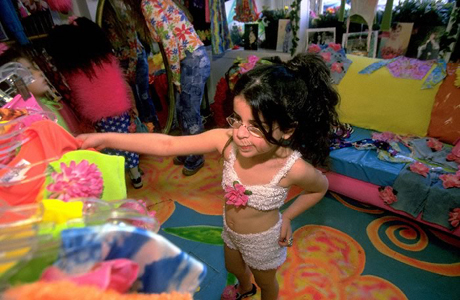
© Lauren Greenfield. Lily, then 5, shops at Rachel London's Garden, where Britney Spears has some of her clothes designed, Los Angeles, California.


palimpsest [pal' imp sest΄ ]
n.
[ L palimpsestus < style="font-style: italic;">palimpsē stos
, lit., rubbed again < palin, again (see PALINDROME) + psē n, to rub smooth < style="font-style: italic;">bhes-, to rub off, pulverize > L sabulum,SAND]


a parchment, tablet, etc. that has been written upon or inscribed two or three times, the previous text or texts having been imperfectly erased and remaining, therefore, still partly visible


"In this work, I have been interested in documenting the pathological in the everyday. I am interested in the tyranny of the popular and thin girls over the ones who don’t fit that mold. I am interested in the competition suffered by the popular girls, and their sense that popularity is not as satisfying as it appears. I am interested in the time-consuming grooming and beauty rituals that are an integral part of daily life. I am interested in the fact that to fall outside the ideal body type is to be a modern-day pariah. I am interested in how girls’ feelings of frustration, anger, and sadness are expressed in physical and self-destructive ways: controlling their food intake, cutting their bodies, being sexually promiscuous. I am interested in the way that the female body has become a palimpsest on which many of our culture’s conflicting messages about femininity are written and rewritten. Most of all, I am interested in the element of performance and exhibitionism that seems to define the contemporary experience of being a girl."
-Lauren Greenfield, From Girl Culture (Chronicle Books, 2002)

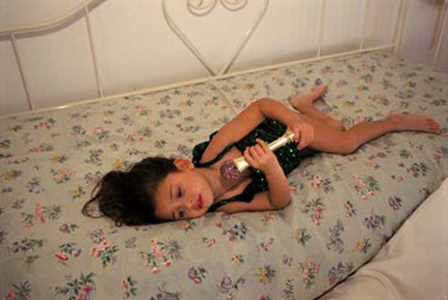
© Lauren Greenfield. Allegra, 4, plays at being a pop star.


© Lauren Greenfield. Fina, 13, in the tanning salon, Edina, Minnesota.


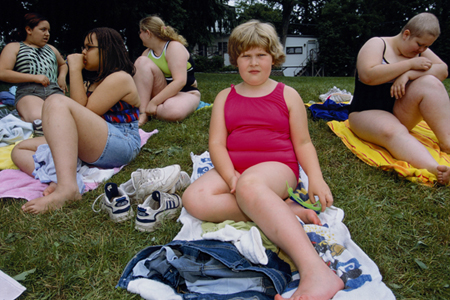
© Lauren Greenfield. Swimming period at Camp Shane, a weight-loss camp, Catskills, New York. Many kids love to swim at camp but will not swim or wear a bathing suit at home.

Saturday, January 31, 2009

Lonely

Barren city street.
Lamplit, lean, coyote waits.
We are lonely, proud.
-g.

“Who knows what true loneliness is - not the conventional word but the naked terror? To the lonely themselves it wears a mask. The most miserable outcast hugs some memory or some illusion.”

-Joseph Conrad

Monday, January 26, 2009

Thank You, Jimmy (for this Beginning, an End.)

This past Saturday, I and ten other Class of '94 churchmates gathered in Hollywood for a funeral. As far as funerals go, it was more of a celebration than a mourning, with soul music and a jaw-dropping rendition of Toccata from Symphony No. 5, by Charles-Marie Widor, played on the pipe organ—but that's not what I'm here to write about. The man we gathered to celebrate was Jimmy, the husband of our class lead, Susan.

It's been fourteen years
now since our class graduated, eighteen or more since most of us met. We are married, we are single, we have children or we don't. We are artists, writers, teachers, managers, computer gurus. We have grown older, fatter, balder, more wrinkled. But at heart we are still the same people we used to be. These are some of the most admirable people I know: kind, pure-hearted, intelligent, true, funny as heck. We're still friends, and we still laugh the way we used to, even at a funeral.

Our bonds were cemented with Susan's burnt brownies and Josh's jello shots. They were built with plastic forks and dewed toilet paper, all-night campfires, Chili Pepper-esque socks, hugs, prayers, the sand between our toes. They were built at beaches, lakes, mountain retreats—and most of all, in the home of Jimmy and Susan.

I remember one night,
Susan told me at the funeral, our house was toilet papered three times. Jimmy loved to give you guys a hard time. He'd shout out the window "We're going to call your parents!" and watch you scatter. At our gatherings, Jimmy was often at the periphery, almost overlooked.
It's not until now, looking back, that I realize the gift Jimmy gave to us: he gave us his home, he gave us Susan. And these were no small things.

When I spoke to Jimmy, I was often surprised at how much he knew about me, how much he remembered. At his funeral, many talked about how he loved to talk to people. He died of cancer, and a couple months before he died, he told my sister he'd like me to come see him, that he wanted me to bring my photographs, to read him one of my stories. I never did. I wasn't sure what to say to a dying man—
How are you? I'm sorry? It's been nice knowing you? Add to this that I wasn't sure what to bring. My photographs seemed too paltry, my writings too sad.

I wish now that I had gone to see him anyway. It might be said that he doesn't care anymore, and I know it's true. But more than my own awkward stutterings, I'd like to know what he would have said. I don't think I'm romanticizing when I say I'm sure it would have been wise, sincere. And that (again) in my fear, I am the one who ultimately missed out.

I did finally figure out what to bring him. It's a broadside of a prose poem and linocut I printed at UCR on the Asbern printing press. I'll post it here.

...And thank you, Jimmy.